Emulsifiers: A Culinary Perspective
Nov 21, 2026

Written by
Simon LovedayWhy do we need emulsifiers when our grandparents cooked delicious food without them? First things first – what’s an emulsifier? It’s an ingredient that helps make an emulsion. What’s an emulsion? It’s just a food with lots of small droplets in it, either droplets of oil in water or droplets of water in oil.
Milk is an emulsion, and yep it contains an emulsifier, even when it’s fresh out of the udder. Inside the udder, milk fat is packaged up into small droplets that are coated with a natural emulsifier that’s a special kind of water-friendly fat called a phospholipid.
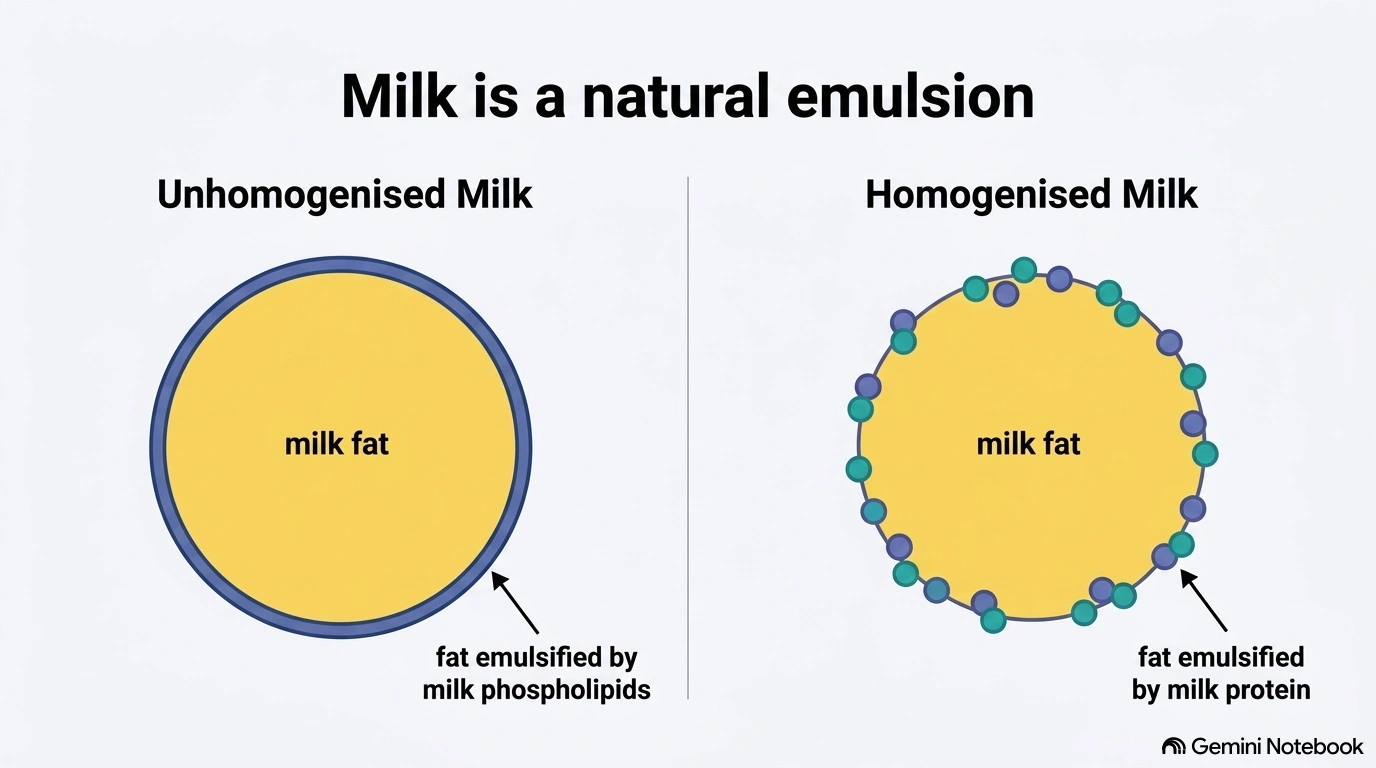
credit: Simon Loveday via Gemini Notebook
When our grandparents churned cream to make butter, the churning broke up fat droplets, releasing the phospholipids into buttermilk, which was separated from the butter. But guess what? Butter is also an emulsion – it contains water droplets surrounded by milk fat. That’s why butter sizzles and bubbles in the pan (water boiling off) but vegetable oil doesn’t.
Sticking with the dairy theme, what happens to that fresh-out-of-the-udder emulsion when milk gets industrially homogenised? It turns into a different kind of emulsion. The fat droplets are broken up into much smaller droplets, and there’s not enough buttermilk phospholipid to cover the smaller droplets, so milk proteins stick to the droplet surfaces instead. Natural protein particles in milk (casein micelles) form a thick layer around milk fat droplets, and when they collide, they bounce off each other instead of coalescing into bigger droplets.
Why would we industrially homogenise milk, instead of drinking it the way nature made it? Not sure about you, but I don’t love having a big lump of fat blocking the neck of the milk bottle, and I’m not a fan of large yellow droplets of fat floating in my coffee. I also don’t love the aroma of rancid milk fat, which is the main reason for homogenising – those protein-covered droplets go rancid much more slowly than buttermilk phospholipid-covered droplets. Is homogenised milk less healthy? Great question! Some former colleagues had a look at that recently – you can see the results here.
You might be thinking this is a ‘bait-and-switch’ piece, where we started talking about industrial emulsifiers and got distracted by buttermilk. The thing is, most industrial emulsifier ingredients are derived from natural food materials – like phospholipids and milk proteins. Lecithins (E322) are phospholipids from plants, although they’re naturally present in egg yolk and organ meats too. Mono- and diglycerides of fatty acids (E471) are another kind of water-friendly fat, a bit like phospholipids.
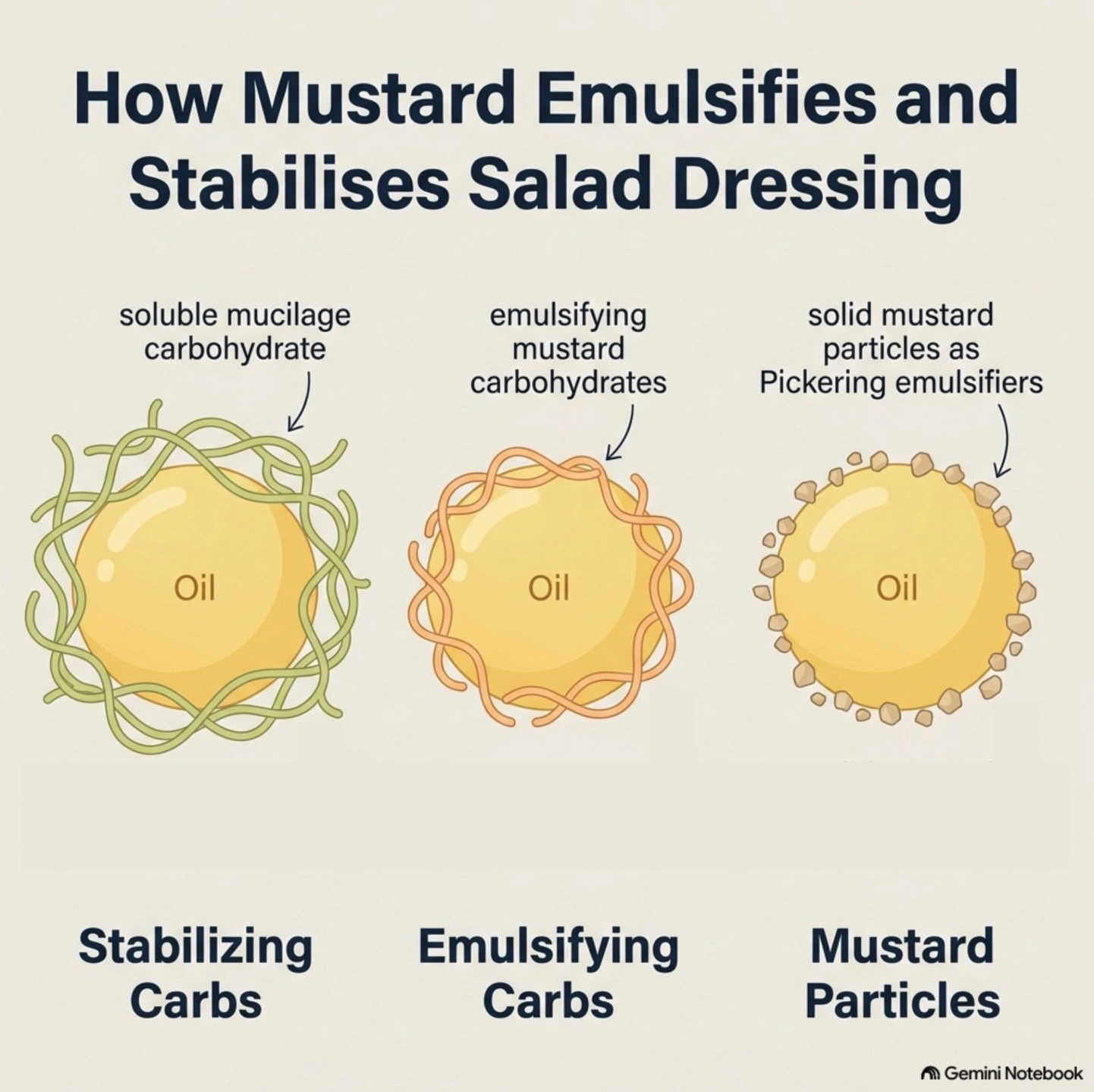
Remember the balsamic vinaigrette from our Thickeners and Stabilisers episode? If I add a pinch of wholegrain mustard powder, the emulsion takes longer to separate. What’s going on? Mustard contains both thickening/stabilising carbs and emulsifying carbs. The thickening carbs slow down oil droplets and the emulsifying carbs armour-plate them so that they bounce off other droplets instead of coalescing and rising faster.
credit: Simon Loveday via Gemini Notebook
Oh, and there’s another thing – all the little fragments of ground-up mustard seed can physically stick onto the surface of EVOO droplets and protect them from each other. We call this a ‘Pickering emulsion’, named after Spencer Pickering who discovered in 1907 that solid particles could act as emulsifiers. Protein particles like casein micelles?? Yep, homogenised milk is a Pickering emulsion!
So did our grandparents use emulsifiers in their home cooking? Only the recipes involving buttermilk (biscuits, pancakes, scones, batters), egg yolk (mayonnaise, aioli, caesar dressing), finely-ground seeds (mustard dressings and chutneys, tahini, hummus), dairy proteins (yoghurt, skyr, cheese, icecream, cream/butter sauces, fondue, kulfi, kheer), organ meats (pâtés, sausages) and a few others. Hmmm… we’ve been eating emulsifiers for a long time!